- ZHUHAI JIALI HARDWARE CO.,LTD.
- +86-756-8586520

Expansion screw, 304 / 316 / color zinc expansion bolt
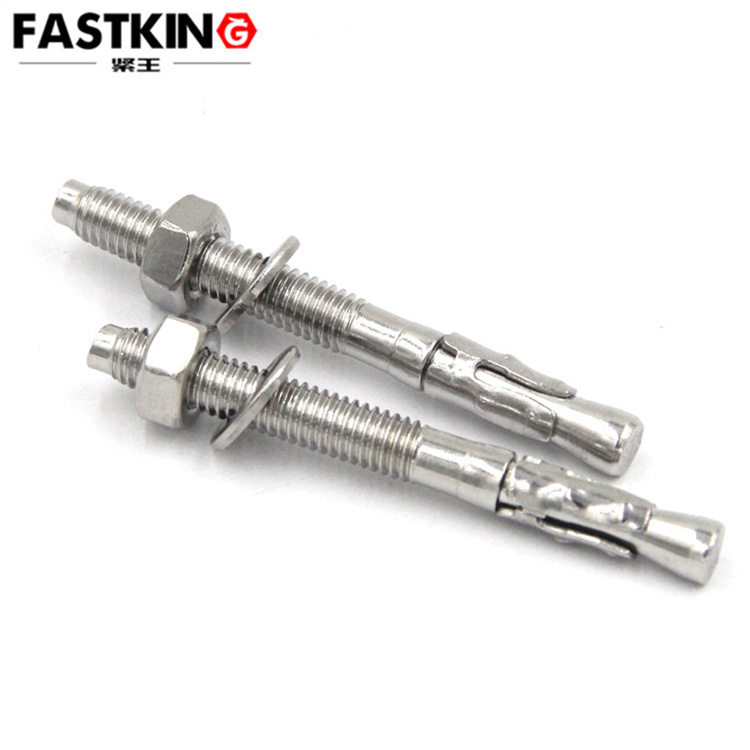
- Product description:Expansion bolt is a kind of special thread connector used to fix the pipe support / Hanger / bracket or equipment on the wall, floor and column. The fixation of expansion screw is to use wedge angle t
Expansion screw, 304 / 316 / color zinc expansion bolt
It can also support non-standard customization.
the expansion bolt is a special threaded fastener designed specifically for "non-detachable fixation". Its core purpose is to stably fix pipeline supports/hangers/brackets and various types of equipment on rigid substrates such as walls, floors, and columns. Different from the "broad-spectrum connection" of stainless steel threaded rods or the "precision positioning" of set screws, it achieves high-strength fixation on substrates without internal threads (such as cement and bricks) relying on the unique principle of "generating gripping force through wedge-shaped expansion", making it an indispensable basic fastener in home decoration and industrial installation.
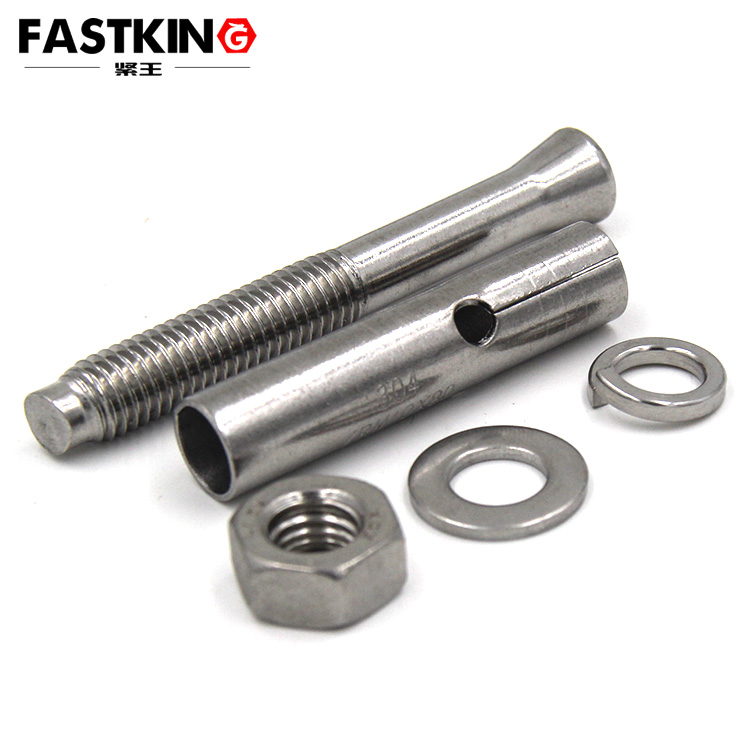
From the perspective of structural composition, the design of the expansion bolt centers on the function of "expansion fixation" and mainly consists of two core components: first, the tapered bolt body — one end of the bolt is processed with standard external threads (for matching with nuts), and the other end has a sharp or blunt tapered structure (the key to the wedge-shaped taper design). The angle and length of the taper must be accurately matched according to the material of the expansion tube and the required fixation strength; second, the thin-walled expansion tube, usually made of metal (e.g., galvanized carbon steel, stainless steel) or high-strength plastic. The surface of the tube may be equipped with anti-slip patterns or open slots, and it is sleeved on the outside of the bolt body. Its inner diameter is slightly smaller than the maximum diameter of the tapered end of the bolt, reserving space for subsequent expansion and deformation. Some expansion bolts are also equipped with flat washers and spring washers to further enhance the anti-loosening effect after the nut is tightened, avoiding loosening caused by vibration during long-term use.
The fixation principle of the expansion bolt completely relies on "expansion friction gripping force caused by wedge-shaped taper", and the entire fixation process can be divided into three key steps: the first step is drilling a hole in the substrate — according to the specifications of the expansion bolt (e.g., M6, M8, M10), a hole with a matching depth and diameter is drilled in substrates such as cement walls and brick walls. The depth of the hole must be slightly greater than the length of the expansion tube to ensure that the expansion tube can be fully embedded; the second step is pre-installation of components — after assembling the expansion tube and the bolt body, they are inserted into the drilled hole together. At this time, the expansion tube is in a natural state, with a small gap between it and the hole wall; the third step is tightening to trigger expansion — use a wrench to turn the nut at the end of the bolt. The nut pulls the bolt outward through thread transmission, forcing the tapered end of the bolt to gradually enter the interior of the expansion tube. Since the diameter of the taper is larger than the inner diameter of the expansion tube, the expansion tube will be "stretched open" by the taper, and the tube body tightly squeezes the hole wall. At the same time, the anti-slip patterns on the surface of the tube body are embedded into the substrate, forming a tight mechanical engagement. Finally, a huge friction gripping force is generated between the expansion tube and the hole wall, firmly "locking" the entire expansion bolt in the substrate to achieve the fixation effect of the equipment or bracket. Once this fixation method is completed, it is difficult to remove the bolt without damaging the substrate or the expansion tube, so it is a typical "one-time fixation".
In terms of application scenarios, the expansion bolt is widely used in various scenarios requiring stable fixation due to its characteristics of "adapting to rigid substrates and high fixation strength". In home decoration and civil scenarios, it is often used for fixing guardrails (balcony and staircase guardrails), outdoor air conditioner brackets, and canopy frames, as well as installing heavy objects such as large lamps, water heaters, and range hoods on walls or floors, ensuring that these components do not shift or fall during long-term use; in industrial and construction scenarios, it can be used for fixing pipeline supports/hangers/brackets (e.g., water pipes, heating pipes, cable tray brackets) and installing small equipment (e.g., power distribution boxes, fire-fighting equipment) on columns and walls, especially suitable for the fixation needs of substrates without internal threads such as cement, bricks, and concrete; in outdoor scenarios, stainless steel expansion bolts, relying on their corrosion resistance, can be used for fixing outdoor billboards and traffic signs, resisting environmental erosion caused by wind and sun exposure.
Compared with the previously introduced stainless steel threaded rods (full-threaded, adjustable connection), the core differences of the expansion bolt lie in the "irreversibility of the fixation method" and "dependence on the substrate" — stainless steel threaded rods can be repeatedly disassembled and adjusted, while expansion bolts are difficult to remove without damage after fixation; stainless steel threaded rods rely on the internal threads of the connected components or the cooperation of nuts, while expansion bolts completely rely on the friction gripping force between the substrate and the expansion tube. When selecting a model, it is necessary to focus on three key factors: substrate strength (large specifications can be selected for cement walls, and thin-walled expansion tubes suitable for brick walls should be selected to avoid cracking), fixed load (select specifications of M8 or above according to the weight of the heavy object), and environmental corrosion (stainless steel materials should be preferred for humid or outdoor scenarios). Only by ensuring that the performance of the expansion bolt fully matches the application scenario can the risk of fixation failure caused by improper model selection be avoided.