- ZHUHAI JIALI HARDWARE CO.,LTD.
- +86-756-8586520

Double Stack Self-Locking Shock-Proof Washer DIN25201
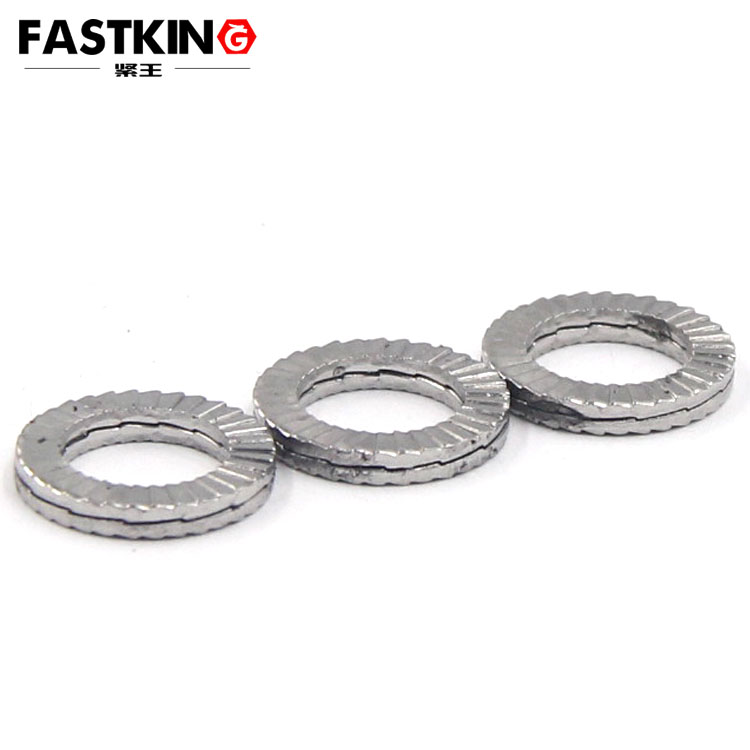
- Product description:Double Stack Self-Locking Shock-Proof Washer DIN25201
|
Name
|
Double Stack Self-Locking Shock-Proof Washer DIN25201
|
|
Size
|
3mm-100mm
|
|
Material
|
S60C, 35CrMo, 51CrV4,SUS304,SUS316L
|
|
Finish
|
Spring Steel Curing in Black, Mechanical Galvanizing, Nickel Plating, Dacromet Coating Treatment
|
|
Brand
|
Fastking
|
The core of the double-stacked washer lies in its "two-piece combination and wedge-shaped inclined surface cooperation". It usually consists of one washer with internal or external teeth and another washer with a wedge-shaped inclined surface. The contact surface between the two washers is not a flat structure but designed as a wedge-shaped inclined surface with a specific angle (common angles range from 30° to 45°). Additionally, the edge of one of the washers is equipped with a fine toothed structure—internal teeth are used to fit the bolt shank, while external teeth are used to attach to the surface of the connected part.
Though this structure seems simple, it hides an ingenious anti-loosening logic: when the bolt is tightened, the wedge-shaped inclined surfaces of the two washers fit closely together, and the toothed structures engage with the bolt shank and the surface of the connected part respectively. When the equipment vibrates during operation and the bolt tends to loosen, the wedge-shaped inclined surfaces generate a "self-locking effect"—minor loosening of the bolt causes the two washers to slide relative to each other along the inclined surfaces. The angle design of the inclined surfaces converts this sliding into reverse pressure, tightly "locking" the bolt and preventing further loosening. Compared with ordinary flat washers that rely solely on friction for anti-loosening, the double-stacked washer’s "mechanical self-locking + toothed engagement" dual anti-loosening mechanism improves anti-loosening reliability by 3 to 5 times. Especially in high-frequency vibration scenarios (such as motors and pumps), it can maintain the bolt’s pre-tightening force for a long time, avoiding equipment failures caused by loosening.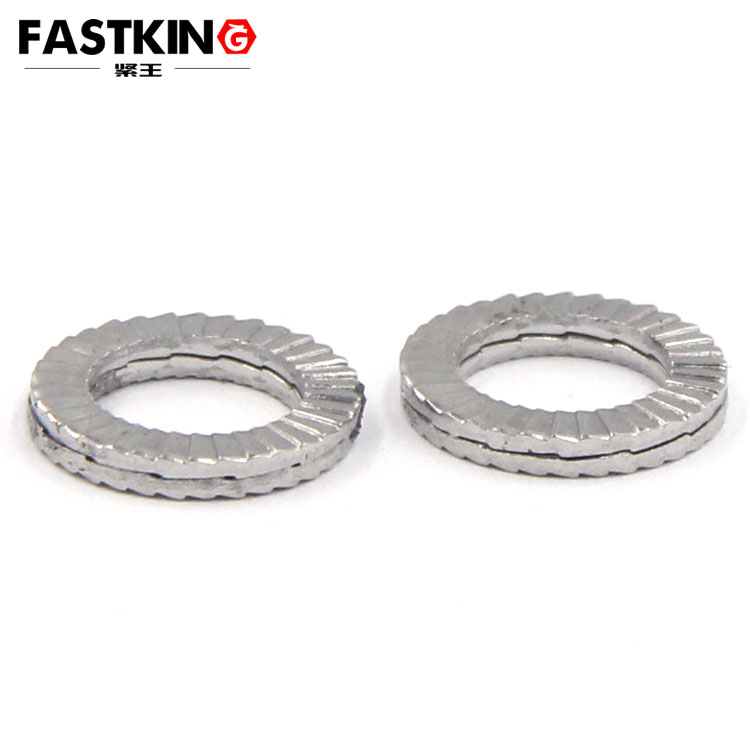
The high safety level of double-stacked washers is reflected in their "all-scenario anti-loosening adaptability". In industrial assembly, there are various complex causes of bolt loosening, including vibration, temperature changes, and load impact. Ordinary washers can usually only deal with a single cause, while double-stacked washers can resolve multiple risks through their structural design. In scenarios with frequent temperature fluctuations (such as automobile engine compartments and chemical reaction kettles), high temperatures during equipment operation cause thermal expansion of bolts and connected parts, which then contract when cooled. This thermal expansion and contraction easily reduce the friction between ordinary washers and bolts, leading to loosening. However, the wedge-shaped inclined surfaces of double-stacked washers can compensate for the gaps caused by temperature changes—even if bolts have minor displacements due to thermal expansion and contraction, the two washers can re-engage through sliding along the inclined surfaces, maintaining stable pre-tightening force.
In load impact scenarios (such as the bucket connection of construction machinery and the wheel axle box of rail transit), instantaneous impact forces easily cause ordinary washers to "bounce", resulting in bolt loosening. The toothed structure of double-stacked washers can penetrate the surface of connected parts (e.g., under the oxide layer of metal components) to form physical engagement. Even when impacted, they can prevent bolt displacement through toothed locking, ensuring the safety of connection nodes.
In specific industrial applications, the "anti-loosening capability" of double-stacked washers has been fully verified. In the rail transit field, wheel-rail vibration during train operation exerts continuous impact on the connecting bolts of carriages and bogies. If ordinary washers are used, bolts need to be retightened every 10,000 to 20,000 kilometers; otherwise, safety accidents may occur. However, when double-stacked washers are paired with bogie bolts, they can withstand long-term high-frequency vibration, extending the bolt maintenance cycle to over 100,000 kilometers, significantly reducing operation and maintenance costs while ensuring train operation safety.
In the aerospace field, the connecting bolts of aircraft engines and fuselages have more stringent anti-loosening requirements—minor bolt loosening may lead to catastrophic consequences. With their lightweight property (mostly made of titanium alloy or high-strength stainless steel) and high anti-loosening reliability, double-stacked washers have become the preferred fasteners for key parts of aircraft. For example, in the connection nodes of aircraft landing gears, double-stacked washers can resist the huge impact forces and vibrations during takeoff and landing, ensuring that landing gears maintain stable connections through thousands of takeoff and landing cycles.
In the heavy machinery field, mining crushers and metallurgical rolling mills have large working loads and severe vibrations. Ordinary washers are easily "shaken loose" by vibrations, causing equipment shutdowns. Through the dual effect of wedge-shaped inclined surfaces and toothed engagement, double-stacked washers can control the bolt loosening rate below 0.1%, ensuring continuous and stable operation of equipment and reducing production losses caused by failures.
The adaptability of double-stacked washers is also reflected in their "compatibility with various fasteners". Whether it is high-strength bolts, ordinary screws, or special-sized non-standard fasteners, double-stacked washers can be matched with them through flexible size design—their inner diameter can be customized according to the nominal diameter of bolts (e.g., M6-M30), and their outer diameter is adapted to the surface size of different connected parts. Moreover, their thickness is only 1.2 to 1.5 times that of ordinary washers, which does not occupy additional assembly space.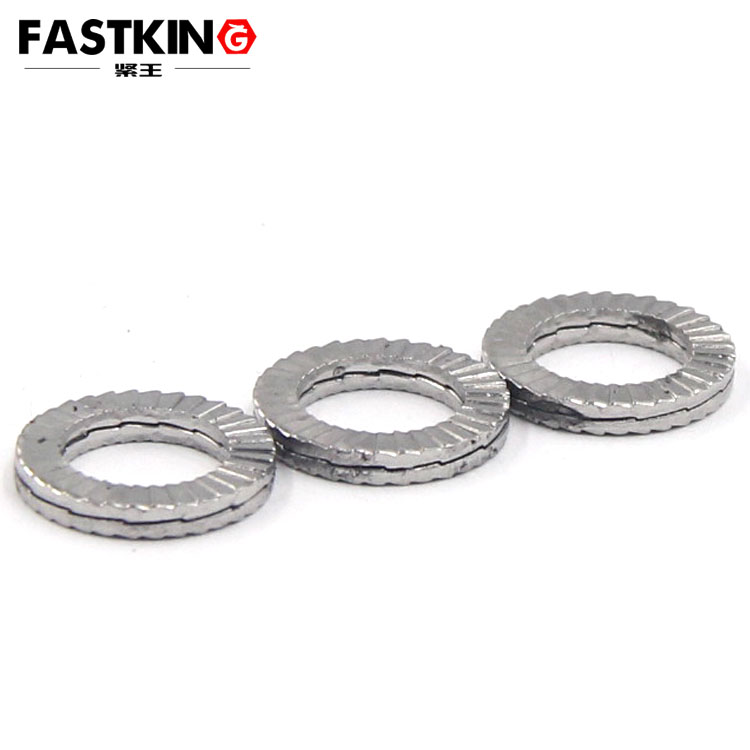
This compatibility gives them obvious advantages in scenarios where multiple specifications of fasteners are used together. For example, in automobile chassis assembly, the chassis uses three specifications of bolts (M8, M10, M12) simultaneously. By equipping double-stacked washers of corresponding sizes, full-node anti-loosening can be achieved without designing separate anti-loosening solutions for different bolts, simplifying supply chain management and assembly processes. In addition, no special tools are required for installing double-stacked washers—workers only need to fit the pre-assembled two-piece washer set onto the bolt like an ordinary washer, which does not increase assembly complexity and balances high safety with operational convenience.
In terms of material selection, double-stacked washers need to balance strength, wear resistance, and corrosion resistance to match the harsh working conditions of different industries. For conventional industrial scenarios (such as ordinary machinery and household appliances), low-carbon steel with galvanized treatment is mostly used, which is low-cost and can meet basic anti-loosening and anti-rust requirements. For high-strength demand scenarios (such as construction machinery and wind power equipment), chrome-vanadium steel or spring steel is selected. After heat treatment, their hardness can reach HRC45-50, enabling them to withstand large pre-tightening forces and impact loads and avoiding washer failure due to stress deformation.
For corrosion-resistant demand scenarios (such as marine equipment and chemical pipelines), double-stacked washers made of stainless steel (304 or 316) are the first choice. The oxide protective film on their surface can resist erosion by salt spray and acid-base media, ensuring that anti-loosening performance does not degrade during long-term use. In lightweight demand scenarios such as aerospace, titanium alloy is used, which greatly reduces weight while ensuring strength, conforming to the "lightweight" design requirements of aircraft.
Although double-stacked washers are often classified as "fasteners" in industrial assembly, their value goes far beyond "connection"—with "anti-loosening" as the core, they resolve loosening problems in industrial scenarios through structural innovation and protect equipment operation safety with high safety levels. From the stable operation of rail transit and the safe takeoff and landing of aerospace vehicles to the continuous production of heavy machinery and the reliable operation of the automotive industry, double-stacked washers always act as "anti-loosening guardians", silently functioning at invisible connection nodes. As industrial manufacturing places increasingly high demands on safety and reliability, double-stacked washers will play a role in more high-end fields, contributing "combined wisdom" and "safety strength" to the high-quality development of the industry.