- ZHUHAI JIALI HARDWARE CO.,LTD.
- +86-756-8586520

Hexagon flange screw - gb5789 / gb5787 / din6921
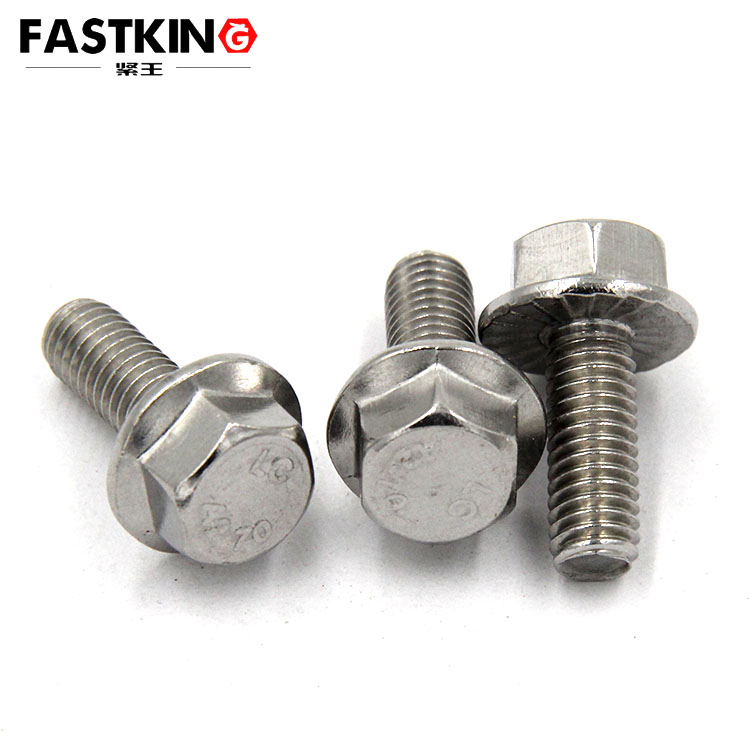
- Product description:Flange bolt: a kind of fastener composed of hexagon head and flange plate (gasket under hexagon is fixed with hexagon, some are flat, some are with flower teeth) and screw (cylinder with external thre
It consists of a hexagonal head and a flange—here, the flange acts as a "built-in washer" fixedly connected to the hexagonal head. Unlike ordinary bolts that require an additional flat washer, this design fundamentally avoids issues such as washer loss or misalignment during installation. The hexagonal head adopts a classic regular hexagonal design, which can form a stable fitting surface with a wrench. Whether using an open-end wrench, a box-end wrench, or a socket wrench, sufficient torque can be easily applied, facilitating quick tightening during installation and easy disassembly during subsequent maintenance. The advantage of the hexagonal structure is particularly evident in working conditions with relatively open spaces.
The design of the flange is divided into two common types: one is a flat flange, with a smooth and flat surface. When in contact with the connected part, it can form an even pressure distribution, effectively protecting the surface of the part from damage. It is especially suitable for connecting components with high surface precision, such as the shell assembly of precision instruments. The other type is a serrated flange, with dense raised tooth-like structures distributed on its bottom. During the tightening process, these serrations can slightly embed into the surface of the connected part (usually made of metal or high-strength plastic), forming an "engagement" effect that greatly enhances anti-slip performance. Even in environments where equipment vibrates for a long time, it can effectively prevent bolt loosening. For example, in scenarios such as connecting components in the automobile engine compartment and fixing the base of large fans, the anti-slip feature of the serrated flange is particularly important.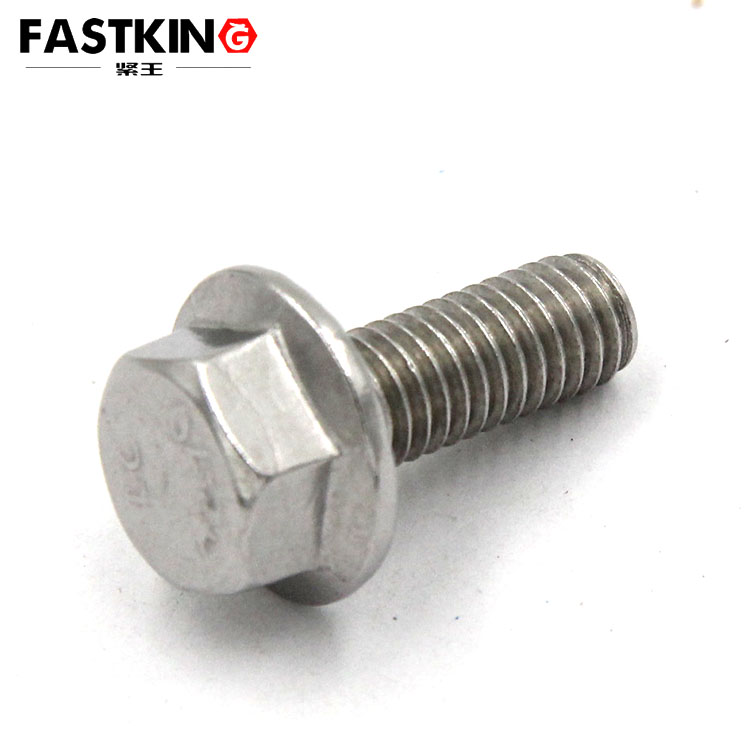
The second part of the flange bolt is the screw rod, which is the core carrier for realizing the fastening function. The screw rod is a cylinder with external threads, and the thread precision and tooth profile (such as ordinary coarse threads and fine threads) are designed according to actual needs—fine threads are suitable for scenarios requiring precise adjustment or bearing vibration loads, while coarse threads are more suitable for rapid assembly. When connecting parts, the screw rod needs to pass through two parts with through-holes, and then be fastened with a nut through thread engagement: the internal thread of the nut closely matches the external thread of the screw rod, and sufficient friction and pre-tightening force are generated between the two by applying torque, firmly "clamping" the two parts in the middle to form a stable connection structure.
This connection form is called "bolt connection", and its most notable advantage lies in "detachability". Different from non-detachable connection methods such as welding and riveting, when equipment maintenance, inspection, or part replacement is required, simply unscrewing the nut from the screw rod with a tool allows easy separation of the two connected parts, and neither the bolt nor the parts themselves will be damaged, enabling repeated use. This feature greatly reduces the cost and difficulty of equipment maintenance: in automobile maintenance, technicians only need to disassemble the flange bolts to replace the engine filter or sensor; in the inspection of ship equipment, the sealed cabin door can be quickly opened by disassembling the flange bolts to inspect the internal components; even for large industrial machinery, the detachability of flange bolts can be used to realize partial replacement of components, avoiding the scrapping of the entire equipment due to small component failures, and significantly improving the service life and operation and maintenance efficiency of the equipment.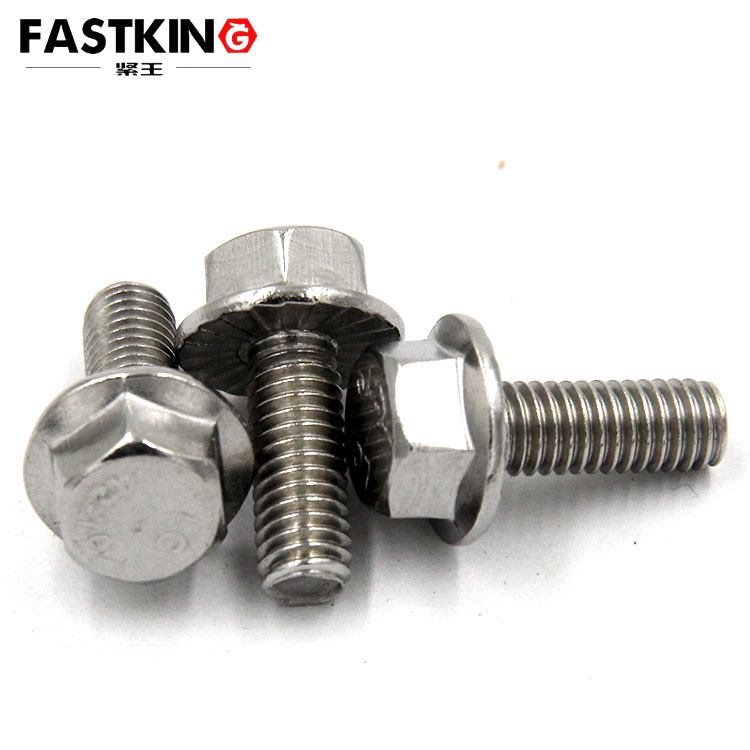
In addition to structure and connection characteristics, the hexagonal flange type of flange bolts also needs to be accurately selected according to actual needs, mainly divided into differences in two dimensions: hexagonal head and flange surface. From the perspective of the hexagonal head, there are mainly two designs: "flat top" and "recessed top". The top of the flat-top hexagonal head is a complete flat surface, with uniform overall structural strength. During the tightening process, it can stably transmit torque to the screw rod, and the head height is relatively high, making it suitable for scenarios with no strict restrictions on installation space, such as the frame connection of large equipment and the auxiliary fixing of building steel structures. The top of the recessed-top hexagonal head is in a centrally concave shape. While ensuring torque transmission efficiency, this design greatly reduces the overall height of the head, making it suitable for working conditions with compact installation space—in narrow areas such as automobile chassis and small motor housings, the recessed-top hexagonal head will not interfere with surrounding components, ensuring smooth assembly.
The difference in flange surfaces further refines the application scenarios of flange bolts: the flat flange surface, with its smooth surface, can avoid scratches and paint peeling on the part surface caused by friction or pressure when connecting parts with easily damaged surfaces (such as plastic housings and coated metal plates). At the same time, the flat contact also facilitates subsequent cleaning or painting of the connection part; the serrated flange surface, relying on its bottom tooth-like structure, shows irreplaceable advantages in environments with frequent vibrations—in the fixing of motors in household appliances such as washing machines and air conditioner outdoor units, the serrated flange surface can prevent bolts from loosening due to equipment operation vibration; in the connection of rail transit equipment components, the serrated flange surface can resist the bumps and vibrations during train operation, ensuring long-term stable connection.